In the second semester of my studies at Exeter, I was exposed to e-commerce and started a course of study that I had never explored before.First of all, I understand that business models that have ideas for new businesses are not business models in themselves. Business success requires not only identifying opportunities, but also matching the right skills and timing in the business or its network.After understanding the basic concepts of the e-commerce model, I created two blogs about me: the change of the sales model in e-commerce and Alibaba and the e-commerce model. This will be my third blog that mainly describes my reflection on this course and the knowledge I have gained by commenting on other people’s articles, and I will use slides to show my future learning and career development of some content of this course.
2. Reflection
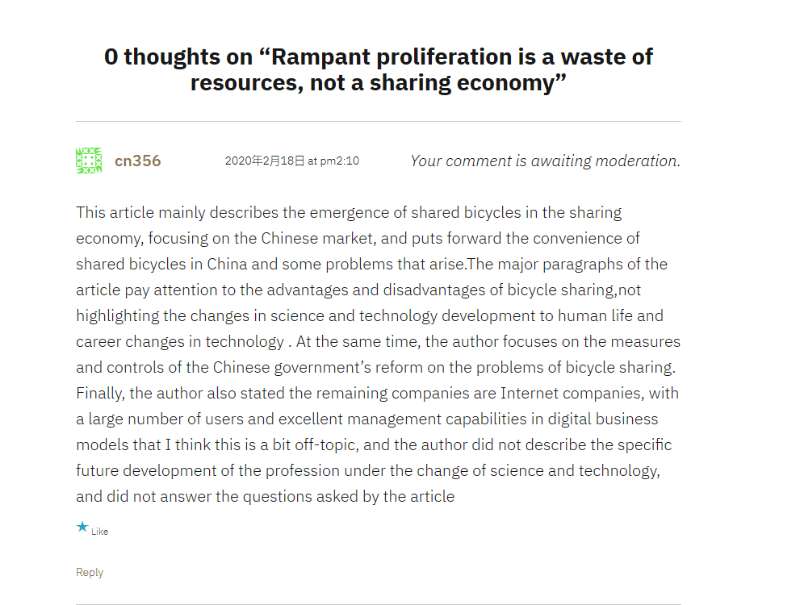
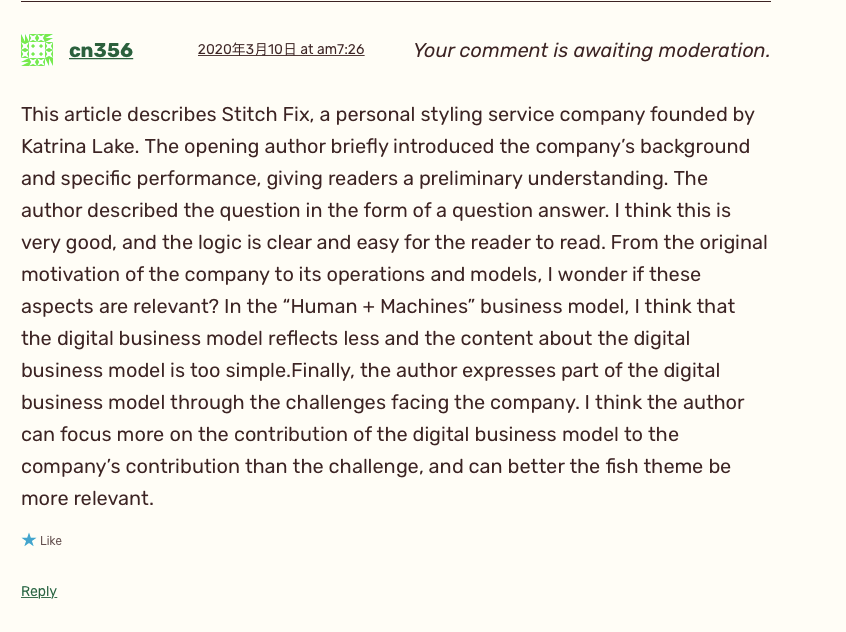
By reading the first report of the two students, I wrote two comments respectively. I think that for the first classmate, I just had a question about describing the article and his topic. But did not realize that in the face of the development of fast digital commerce, self-service pickup is very inconvenient for the elderly to collect express delivery. This and my first article did not address the issues that specific groups of people need to face under the development of digital commerce.(Bryson,2019) Through the reading of many students’ articles and group practice, I am amazed that the digital economy model has changed many professions. I also learned that new types of careers are gradually emerging. “After becoming a digital manager, they have successfully helped more than 10 startups build organizational structures, personnel structures, and management systems.” (Yeaton,2018)
On the subject of the second article, I used Alibaba to evaluate the contribution of digital business models to success. Through my comments on other students’ articles, I think that my article structure is not clear enough, and I have not used my own experience to describe it, which needs to be improved.I also learned through themes that Uber and other self-employed companies have successfully developed through the digital economy model. At the same time, I believe that in the context of information technology and the reality of big data, the digital economy model can create value. However, due to the popularity of intelligent technology, the conflict between machines and humans is obvious.
3. Future Learn
(Xuan, 2018)
4. Reference
Yeaton, T.(2018).Strengthen international coordination to deal with the digital economy. Brighton:China Economic Times.
September 10, 2019 is the 20th anniversary of the founding of Alibaba. At the close on September 9, Alibaba’s market value was fixed at 462.863 billion U.S. dollars, steadily ranking among the top ten in the world, and being the highest Chinese company by market value. (Du, 2018). So successful Alibaba cannot do without its operating model. The Alibaba Group covers many areas, such as: Taobao, Tmall, JuChu, Alibaba Software, Taohua, Yahoo China. At the same time, it also acquired American e-commerce SaaS provider Vendio Services and Gaode UC, which has the largest digital business model in the world. This article focuses on assessing the tremendous contribution that Alibaba has made under the digital business model. We all know that Alibaba cannot operate without Taobao. Taobao is very familiar to every Chinese. However, how the digital business model creates the Alibaba Group is unknown to us. In the era of digital commerce, Alibaba is the wave of the digital economy, a sample of the development of Chinese enterprises. From an e-commerce company to a digital economy spanning the fields of commerce, finance, logistics, cloud computing, etc., the digital economy model has changed Alibaba tremendously in the past two decades.
Alibaba Group has a lot of its own business, and there are many related companies to support the business. In 2003, Alibaba began preparations for the establishment of Taobao.com. Alibaba started with B2B (business-to-business) business, while Taobao is a C2C (person-to-person) model. (Dan, 2019) When the digital economy model was not yet the mainstream of the world’s development, Taobao was launched in May 2003 as the main online retail and commercial area of the Alibaba Group’s Asia-Pacific region. The third-party payment tool “Alipay” was launched in October, enabling consumers to transact online and Taobao through the “guaranteed transaction model.” (Aashish, 2019). After Taobao’s online shopping became more and more popular, physical store shopping was gradually replaced, and more and more digital business models contributed to Alibaba Group. First, when customers shop on Taobao, Alibaba Group can automatically recommend other products that customers may like, need and afford. Customers’ browsing history and purchase records can be analyzed specifically by Alibaba through the Internet and even external networks. Therefore, Alibaba’s promotion of precision marketing is to recommend products that customers may like, which is also one of the contributions of “digital digital business model” to Alibaba. This has, to a certain extent, increased consumer purchase rates and greatly increased Alibaba’s turnover. Second, “decentralization” is also the biggest advantage of the digital economy model block chain! When Alibaba started to launch decentralized digital business model QR code payment, Alibaba’s Alipay shopping quickly became the mainstream consumer payment tool in China. Customers only need to scan the QR code to have their favorite items. There is no need to bring cash, and a mobile phone can go out or travel. Consumers can now buy essentials at home. The promotion of Alipay allows consumers to buy anytime, anywhere. Mobile payment can more specifically use big data to track customer information and make reasonable improvements to its products based on this information. You can also develop corresponding marketing activities through the analysis of these big data. Finally, Alibaba proposed intelligent logistics, which is artificial intelligence for the digital economy model. Parcels can now be sorted automatically. They enter and leave the warehouse by themselves. No one needs to drive a vehicle. They can also use drones to other distribution locations and use smart express cabinets to pick up goods. These are controlled by warehouse robots. The “smart, unmanned, one-stop” logistics model of the digital business model has greatly helped save talent costs and optimize talent utilization. The big wave of digital business models is accelerating across every corner of every industry, reshaping business, and changing society. Innovative digital business models such as big data, cloud computing and mobile internet have all contributed to the success of the Alibaba Group. Thanks to Alibaba’s pioneering work, the digitalization of Chinese consumers can be said to have led the world. Alibaba has formed a commercial operating system, and it is also a digital business model system. Alibaba’s commercial operating system is designed to make it easier and more efficient for businesses to do business in the digital economy. “
3. Conclusion
Mayun
The digital business model has helped Alibaba gradually create miracles in the history of world enterprise development. The digital economic model has brought great changes to human beings. Alibaba Group no longer chooses to shop in physical stores. The changes in payment methods brought by online shopping are all digital economic models, which is a testimony of the success of Alibaba Group. (Ming, 2018) All major decisions in Ali’s history have nothing to do with money and have to do with the concept of business model. It is precisely because of this unique model that drives the development of Alibaba and provides more references for the development of enterprises in the digital economy era.
4. Reference
Du, M. (2018).What is digital commerce.Brighton:Havard Business articles Journal.
The world is entering a new era of digital economy. With the advent of artificial intelligence, our lives are constantly changing. The disappearance of banknotes, the birth of takeaways, unmanned supermarkets, unmanned hotels, unmanned self-service banks, the traditional physical industry is changing to the network industry. The disappearance of fee-based services, the advent of the intelligent era, affects our lives and also affects the social form. Now the cost of society is getting higher and higher. Industry, education, culture, and interpersonal relationships are all changing as the digital economy changes. The digital age has indeed solved many problems in life, making us more convenient and effective.
2. Main body
2.1 physical stores sales changed in the digital economy
The era of digital economy development is not just about changing an industry, several fields, it’s that simple. It is changing all industries and even more emerging industries. Its appearance has brought us great convenience, and the lifestyles of travel, shopping, medical treatment and transactions have changed greatly. However, there is a bottleneck in a career replaced by the Internet. These people are sales in some physical stores. At first, Internet sales services were welcomed by many people due to their low price and wide range of advantages. Therefore, because of the impact of the Internet, many large and small stores around the world have gone bankrupt due to lack of traffic, and the rate of entrepreneurship has dropped dramatically, the profit of physical store sales is far more than that of Internet sales. (Wu, 2019). Internet sales cover all physical industries, whether working, setting up stalls, opening stores, opening companies, or doing business, most of them have been replaced by Internet sales. At the same time, the “Industrial Internet” covers all physical factories. If the factory is not upgraded to the “Industrial Internet”, it will be difficult to face the challenges of the future market. “New retail” covers all physical industries, because without good stores, companies, factories, will face crisis. New retail is also an industry that integrates the Internet, transforms, upgrades, and innovates. Finally, “AI artificial intelligence” also covers all physical industries, and future changes are bound to be the era of competition between humans and robots, the Internet and physical stores. According to the current survey, as the main consumer groups are younger, the entrepreneurial subjects of Internet platforms are getting younger and younger, and Internet sales continue to be a trend in entrepreneurship. On the Ali retail platform, more than 60% of the shop owners are aged 30 and under, and young people are becoming the backbone of entrepreneurship.(Stephanie, 2017).
2.2 physical stores sales change further in the future
According to the survey, in the future physical store sales must be highly integrated with online sales. Moreover, large-scale supermarkets are likely to develop in the direction of experience stores. At the same time, 5G has been widely used after five years. 5G communication has fast transmission speed and cheap data, which will allow customers to further migrate from PC to mobile, which will definitely promote the further development of the digital economy. Currently, more physical store traffic is shifting to online e-commerce. (Rhian, 2018)More and more people choose to buy things online, which will undoubtedly put more pressure on physical stores. Especially those products with intense competition and poor experience are not suitable for operating in physical stores. Therefore, the physical store needs to develop in a more experiential direction in the future, and the disadvantage of online stores is that the experience is poor, and the vitality of physical stores is that they have a direct sensory experience. As people’s income levels rise, consumption levels will grow. Therefore, brick-and-mortar stores will inevitably improve the store level and move closer to the middle and middle income groups.(Kimberly, 2020)Physical stores must guarantee high quality to win the market. The high-end consumer population will further expand, luxury goods sales will become more and more prosperous, and luxury store business will become better and better. The rise of e-commerce and the decline of the physical industry are an inevitable phenomenon of social development. Only competition in the physical store industry can make progress. Secondly, many physical industries cannot be replaced by e-commerce, such as restaurants, hotels, KTV, etc. These service-winning industries cannot be given through the Internet. A great shopping experience is totally different from shopping online.
3. Conclusion
In general, from the sale of physical stores without the Internet era to the subsequent sales of e-commerce companies such as Alibaba, it has brought huge changes in people’s lives and sales professions. I think the physical store will be a good business under the reinvention of the Internet. Under the blessings of big data, cloud computing, and artificial intelligence, although online and offline, there are also disadvantages, and the biggest advantage of physical stores is experience, which is currently not possible with online platforms. In the next few years, I believe that the pursuit of experience will become a goal optimized by major physical stores.






 cn356
cn356 